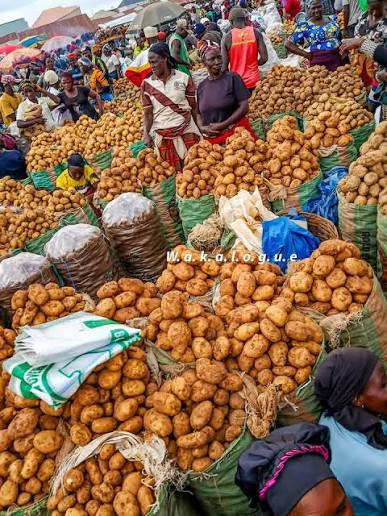
A stakeholder in Nigeria’s agricultural sector laments the country’s inability to export Irish potato directly to European markets, noting that the produce must first pass through Ghana before reaching its destination.
The Plateau State Chairman of Agricultural Allied Employees, Mr. Nannim Zwalda, made the remark on Friday on the sidelines of the 2026 Workers’ Day celebration held at the Polo Field in Jos, the State capital.
Zwalda expressed concern that despite the large-scale production and growing international acceptance of Irish potato, recently rebranded as “Plateau Potato” by the state government, Nigeria is yet to establish a direct export route to key European markets.
According to him, the current export structure, which routes the commodity through Ghana, poses a major setback to the sector and the nation’s economy.
“The designated export route is Ghana within West Africa. You cannot export Irish potato directly from Nigeria to some European countries like America; it must pass through Ghana. This is a major challenge affecting both the agricultural sector and the Nigerian economy,” he said.
He added that the arrangement contributes to economic losses and currency devaluation, stressing that a direct export system would significantly improve revenue generation.
Zwalda therefore called on the Federal Government and the Plateau State Government to strengthen infrastructure, particularly by improving cargo operations at the State’s airport to facilitate direct international exports.
He noted that such improvements would not only boost the morale of stakeholders in the agricultural sector but also support the export of other produce such as vegetables, fruits, and root crops, for which Plateau State is known for.
He further explained that direct exportation would eliminate multiple taxation faced by farmers and marketers, thereby encouraging greater participation across the value chain.
Findings indicate that Plateau State remains the leading producer of Irish potato in Nigeria, contributing between 80 and 90 percent of national output. Major production hubs include Mangu, Bokkos, Barkin Ladi, and Jos South Local Government Areas, where the cool climate supports optimal cultivation of the crop.
About The Author



More Stories
PIDAN Retreat: Plateau Leaders Push Unity, Peace and Responsible Mining
Cattle Policies: PSA UK Demands Inclusive Dialogue With Affected Communities
Mutfwang Flags Off 500-Cattle-Per-Day Abattoir, Targets Livestock Revolution in Plateau.