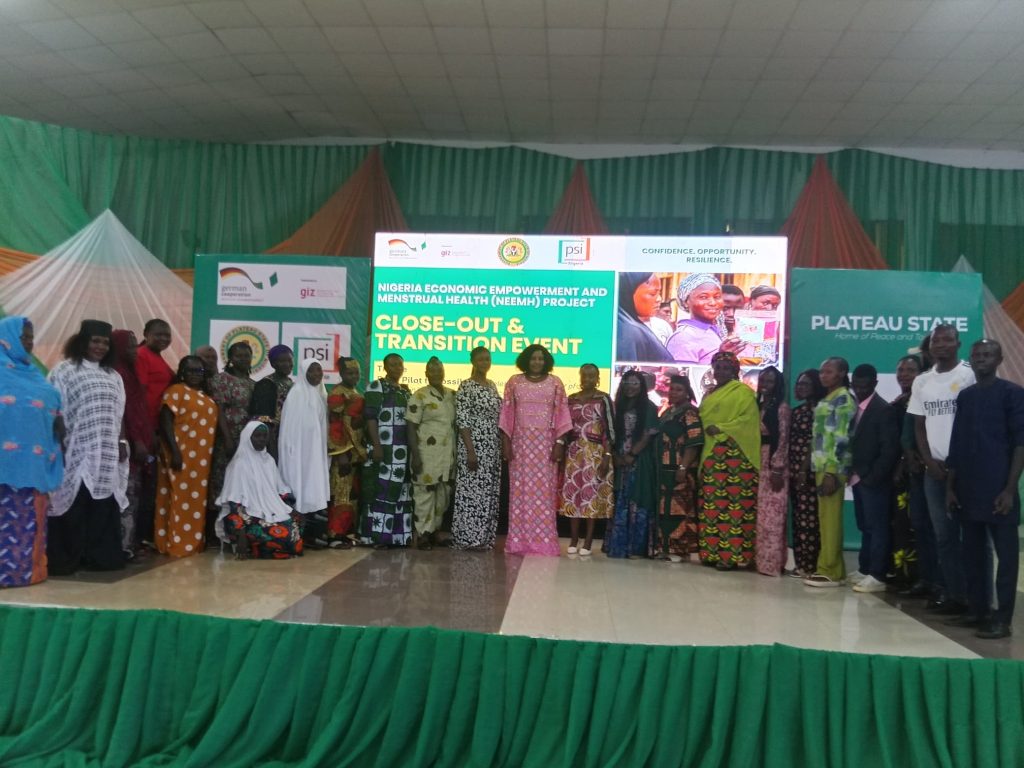
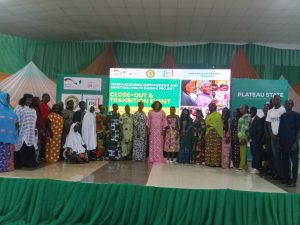
The Plateau State Government has pledged to sustain the gains of the Nigeria Economic Empowerment and Menstrual Health (NEEMH) Project following the completion of its pilot phase, which reached 16,438 women and girls across six local government areas of the state.
The commitment was made at the project’s close-out and transition ceremony held on Tuesday, at Crispan Hotel, Jos, the state capital, where government officials, development partners, civil society organisations and community representatives reviewed the project’s achievements and discussed ways to sustain its impact.
The project, implemented by Population Services International (PSI) Nigeria in partnership with civil society organisations, combined menstrual health education with women’s economic empowerment, particularly in communities affected by conflict and economic hardship.
Speaking at the event, Plateau State Commissioner for Women Affairs and Social Development, Caroline Panglang Dafur, said the state government had formally endorsed the project’s outcomes and was committed to ensuring that its benefits continued beyond the pilot period.
Dafur, who described the theme of the ceremony as “From Pilot to Possibility,” said the occasion was not merely to mark the end of an intervention but to take responsibility for sustaining the progress recorded in benefiting communities.
According to her, the project reached out to women and girls across Bassa, Riyom, Bokkos, Mangu, Shendam and Wase local government areas, established 18 women’s collectives and trained 54 Menstrual Health Champions to promote awareness and provide community-level support.
She said the initiative had helped women improve their livelihoods and financial management while enabling girls and women to access menstrual health information and address the stigma often associated with menstruation.
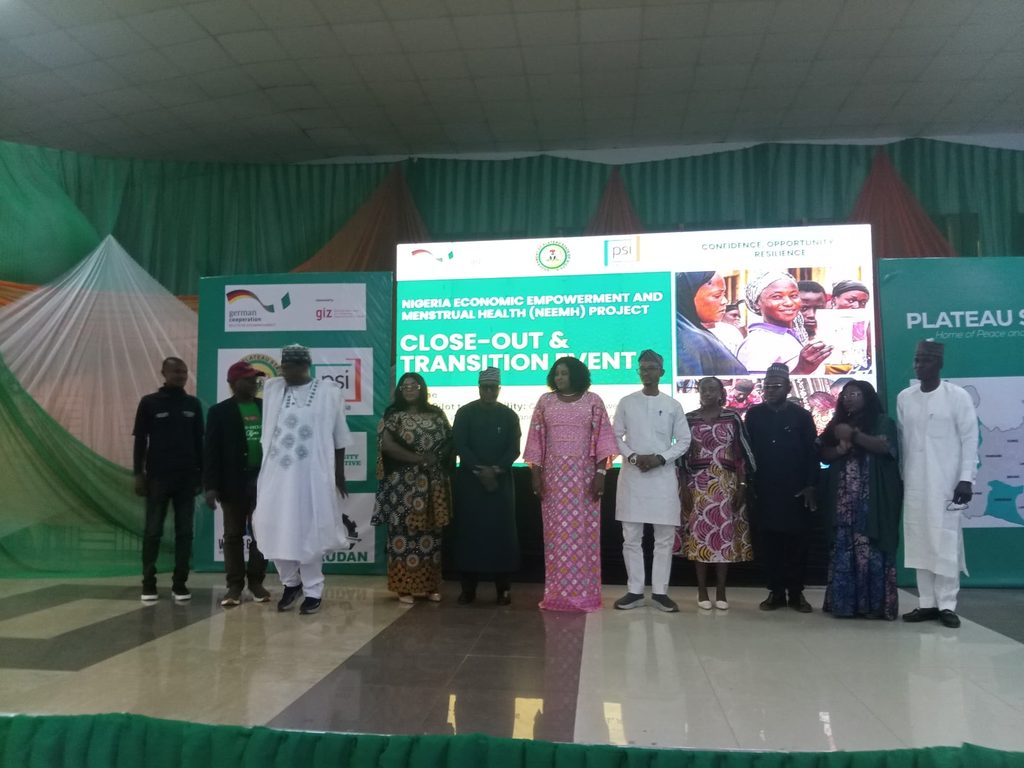
The commissioner stressed that the project’s implementation through government structures had strengthened local ownership, which she described as essential to its long-term sustainability.
She explained that the ministry would work through Women Affairs Desk at the local government level to support the women’s collectives and connect them with state empowerment programmes, cooperative societies, credit facilities and market opportunities.
Dafur added that the ministries of Commerce and Agriculture, alongside the Plateau State Microfinance Development Agency (PLASMIDA) and the Plateau Agricultural Development Programme (PADP), would be engaged to help women-owned businesses expand beyond subsistence activities.
She also pledged closer collaboration with the Ministry of Health and the State Primary Health Care Board to integrate menstrual health education into primary healthcare services and sustain the work of trained community champions.
The commissioner said the government intended to incorporate the commitments into the ministry’s annual operational plans and budgets to ensure that women’s economic empowerment and menstrual health remained part of its development priorities.
Earlier, the Head of GIZ’s PEACECORE II Project, Myriam Wedraogo, commended the Plateau State Government, PSI Nigeria, civil society partners and community leaders for their contributions to the implementation of the initiative.
Wedraogo said the project, supported by Germany’s Federal Ministry for Economic Cooperation and Development (BMZ) through the German development agency GIZ, addressed two closely connected needs: women’s economic resilience and their ability to manage menstruation with dignity.
She identified government ownership, community participation, the involvement of men and traditional leaders, and sustained access to finance and markets as important lessons from the project.
According to her, training alone cannot guarantee sustainable livelihoods unless women can access the resources, mentoring, land and markets needed to turn their skills into viable businesses.
She further noted that bringing women together around shared economic interests could strengthen trust, cooperation and peaceful coexistence, particularly in communities recovering from conflict.
Representing PSI Nigeria, Sani Lawal Yaro, who delivered a welcome address on behalf of Benson Ohemu Okpe, appreciated the project’s sponsors, implementing partners and other stakeholders for their contributions to its implementation in Plateau State.
Yaro also acknowledged the state government’s willingness to take ownership of the project and continue supporting its activities following the transition.
In a keynote address delivered on behalf of the Federal Ministry of Women Affairs and Social Development, the Director of Economic Services, Musa Aliyu Musa described women’s economic empowerment as an important strategy for national development, conflict recovery and sustainable peace.
The Director argued that economic empowerment should not be treated as charity but as a practical investment in household welfare, community stability and national prosperity.
The federal official highlighted the National Women’s Economic Empowerment Policy, launched in 2023, as a framework for improving women’s access to finance, markets and skills while addressing social and economic barriers to their participation in productive activities.
The address also called for stronger support for women-led enterprises, improved access to affordable financing and the expansion of viable livelihood opportunities in conflict-affected communities.
It further urged state governments to adopt and fund the national policy, integrate menstrual health into their development plans and provide budgetary support for menstrual health and hygiene programmes in the education, health and women affairs sectors.
The official encouraged development partners to move beyond pilot projects and support the implementation of established policies, while urging private businesses to invest in women’s enterprises and supply chains.
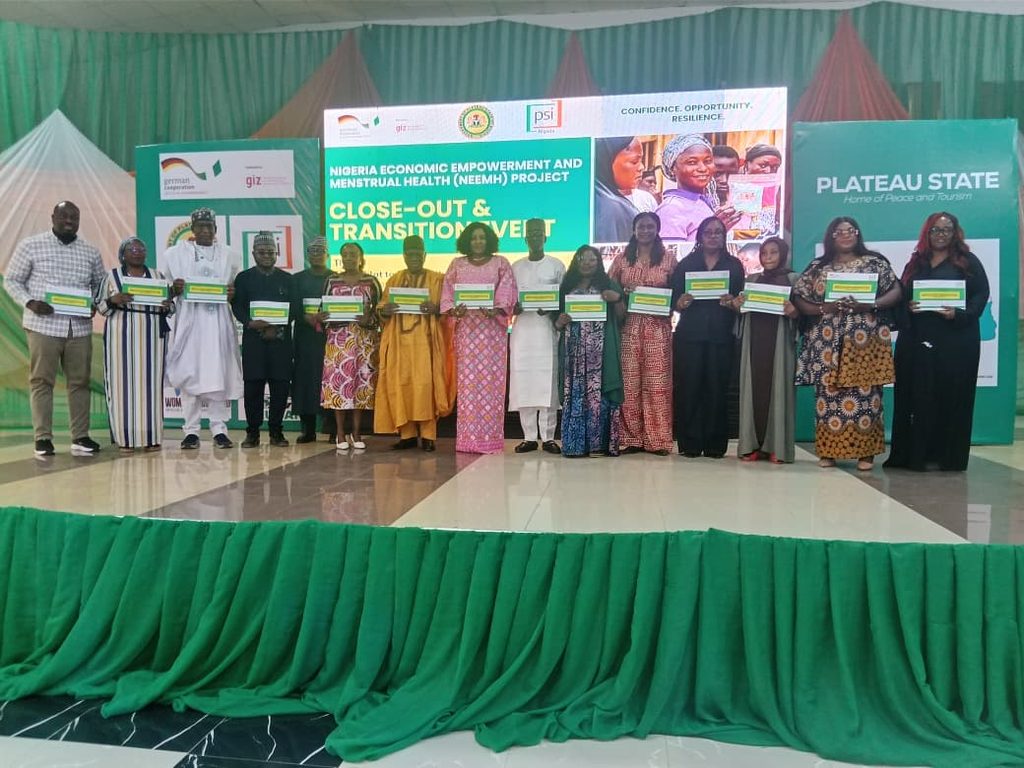
Giving an overview of the project, Senior Program Officer of the project, Winnifred Kwaknat of PSI Nigeria explained that NEEMH was implemented from March 2025 to October 2026 in the six benefiting local government areas, with the Plateau State Ministry of Women Affairs and Social Development coordinating the state’s participation.
The programme supported 18 women’s collectives, comprising hundreds of women who received business and financial literacy training to improve savings, record-keeping and enterprise management. Project figures presented at the ceremony also showed that 54 Menstrual Health Champions were trained to share information and promote informed discussions about menstruation within their communities.
The project further engaged 2,359 men and boys in menstrual health awareness and worked with religious and traditional leaders to challenge misconceptions and encourage supportive attitudes towards women and girls.
As part of its livelihood component, the initiative supported the production of 1,500 menstrual health products, assisted 305 women producers and established links with Highland, Lowland and Bokkos microfinance banks to improve access to financial services and strengthen business prospects.
Dignity kits were also provided to displaced women and girls, reflecting the project’s efforts to reach vulnerable groups affected by insecurity and displacement.
Beneficiaries from the six local government areas shared testimonies about how the intervention had influenced their confidence, financial management and understanding of menstrual health.
Lydia Ransa, a Menstrual Health Champion from Kwall in Bassa Local Government Area, said the training had increased her confidence and positively influenced her personal life.
Another beneficiary from Wase said the village savings and financial literacy training had helped her make better investment decisions, manage her finances and keep records of her business growth.
Similarly, Chundung, a teacher and Menstrual Health Champion in Riyom, said the initiative had increased awareness among men and women about menstrual health and personal hygiene.
The ceremony featured goodwill messages, the presentation of awards to outstanding staff and individuals, and special gifts to people recognised for their contributions to the project’s success. A video documentary highlighting the implementation and impact of the intervention was also screened, while the NEEMH Implementation Brief was launched to document the project’s experiences, results and lessons for future programming.
The transition marked the beginning of a new phase in which government institutions, development partners and community structures are expected to build on the gains recorded during implementation. The six benefiting local government areas comprise Bassa and Riyom in the Northern Senatorial Zone, Bokkos and Mangu in the Central Senatorial Zone, and Shendam and Wase in the Southern Senatorial Zone.
NEEMH was funded by BMZ through GIZ and implemented by PSI Nigeria in partnership with the Christian Rural and Urban Development Association of Nigeria (CRUDAN), the Women and Girls Rescue and Development Initiative (WGRDI), and ICIN, alongside relevant state ministries, agencies and community stakeholders.
The project’s transition places responsibility on the state government and its partners to maintain the women’s collectives, strengthen access to markets and finance, support community-based menstrual health education and ensure that the progress made during the pilot phase translates into lasting improvement in the lives of women and girls across Plateau State.
About The Author

More Stories
Plateau Assembly Moves to Assess MDAs’ Budget Performance Ahead of 2027 Budget
Cooperative Federation of Nigeria Tasked To Deepen Impact At 10th National Summit.
COCIN Shalom Multipurpose Coorporative Launches Table Water