Health experts and other stakeholders in Plateau State have expressed support for a bill seeking to regulate surrogacy arrangements and related Assisted Reproductive Technology practices in the state.
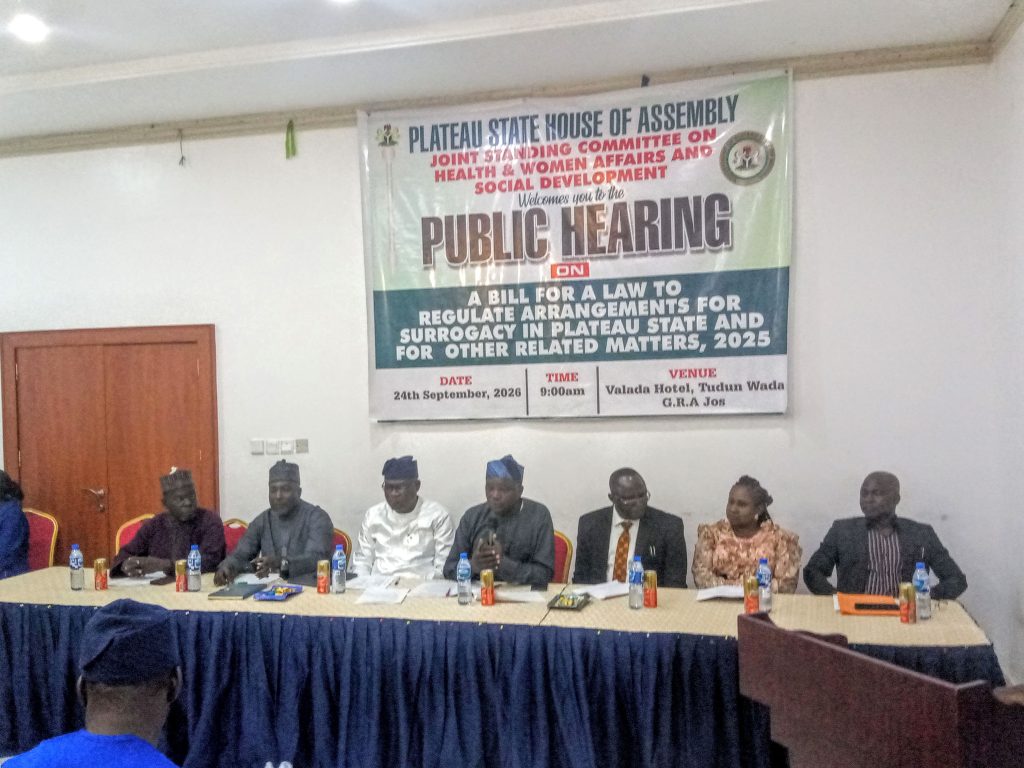
The stakeholders made their positions known on Thursday at a public hearing organised by the Joint Standing Committees on Health, Women Affairs and Social Development, Plateau State House of Assembly held at Valada Hotel, Jos.
The proposed legislation, titled a Bill for a Law to Regulate Arrangements for Surrogacy in Plateau State and Other Related Matters, is aimed at establishing a legal and regulatory framework for surrogacy while protecting the rights and welfare of surrogate mothers and children.
Addressing stakeholders before receiving their submissions, the Deputy Chairman of the House Committee on Health and member representing Langtang North Central Constituency, Hon. Daniel Nanbol Listick, urged participants to freely express their views on the bill, whether in support or against it.
Listick said the contributions of stakeholders would assist the legislature in improving the bill before its eventual passage, stressing that their expertise and practical experiences were important to the legislative process.
Presenting the submission of the Plateau State Ministry of Health, the Commissioner for Health, Dr. Nicholas Ba’amlong, said the ministry supported the bill but called for amendments and clearer provisions to address some of the issues identified by the ministry.
Ba’amlong said, “This is an important time. As a ministry, this is a welcome development, because we believe that promoting Assisted Reproductive Technology is a sustainable effort.” He, however, urged the committee to consult more widely with relevant professionals, particularly medical practitioners.
The Commissioner also called for clearer definitions of key terms used in the bill, including “surrogacy arrangement,” “surrogate mother” and “intended parents,” arguing that some of the provisions could create ambiguity if not properly defined.
He further recommended that the proposed regulatory framework should be placed under the supervision of the Ministry of Health rather than establishing a separate commission, a position that was also supported by several stakeholders.
The Chairperson of the Plateau State Gender and Equal Opportunity Commission, Barr. Olivia Dazem, said the commission supported the need for legislation because commercial surrogacy was already taking place in parts of the state and required regulation.
Dazem said, “Because we have commercial surrogacy ongoing in parts of the state, we need a law to regulate it. We need a law to control it.” She expressed concern that the commercialisation of surrogacy could expose vulnerable women, particularly young women, to exploitation.
She recalled an instance involving a surrogate mother who allegedly advertised the practice within her community, attracting the attention of residents who were concerned about the financial inducements being offered to women to become surrogate mothers.
The Commissioner for Women Affairs and Social Development, represented at the hearing by a Director in the ministry, Mrs. Maureen Dakim, said the ministry supported the objectives of the bill but urged lawmakers to strengthen its operative clauses to adequately protect women and children.
Dakim said, “We support the aim of the Bill to prevent surrogacy and to discourage commercial surrogacy. There should be provision to protect the rights of women and children and the wellbeing of the women and children as well as the welfare of surrogates and children.”
She recommended that surrogate mothers should give free and informed consent, supported by independent counselling and legal advice provided in a language they understand, while also receiving appropriate medical care and insurance throughout pregnancy, childbirth and the postpartum period at the cost of the intended parents.
The submissions of other health institutions, including Plateau State Specialist Hospital and Jos University Teaching Hospital JUTH, were also presented, with the institutions expressing support for the bill while making recommendations for its improvement.
The bill’s sponsor, Prof. Theodore Maiyaki, alongside members of the Joint Standing Committees and other stakeholders, participated in the public hearing, which was aimed at gathering views to strengthen the proposed legislation.
If passed into law, the legislation would provide a framework for regulating surrogacy arrangements in Plateau State, with emphasis on protecting the rights, health, welfare and informed consent of surrogate mothers and children, while addressing concerns surrounding commercial exploitation.
About The Author



More Stories
COCIN Shalom Multipurpose Coorporative Launches Table Water
Plateau Activates Incident Management System as Diphtheria Cases Rise to 469
JSI Calls on Citizens to Become HPV Vaccine Champions