A Rejoinder to Al-Amin Isa’s Hilarious Defense of the Fulani Immigrant Ahmadu Bello
Barr John Apollos Maton
17th May 2026
I will start by saying if nothing is taken away from this entire piece, just remember that Fulani are Immigrants and can never be Indigenes of any part of Nigeria as they are not native to any part of Nigeria. The fact that they have for decades waged this war of attrition and imperialism against the true natives of Nigeria should not let any of us native and indigenous peoples forget that they are not part of us and should never be accepted as part of us. Of all the immigrants who have over the decades come to Nigeria, Fulani are the only ones who feel entitled to what is ours and demand we quietly surrender our ancestral lands and lives for their domination and modern-day colonialism.
Their terrorism should not let us yield in fear; we should not give in to cowards who ravage our villages at night, kill innocent people and take over our ancestral lands while the government is silent.
Al-Amin Isa’s defense of Sir Ahmadu Bello, the Sardauna of Sokoto, is itself a masterclass in the very historical mischief he accuses others of committing. He demands evidence. He invokes scholarship. He calls for rigor. Yet he constructs his defense entirely upon the premise that Sardauna was, at worst, a well-intentioned regional patriot whose legacy has been unfairly besmirched. This is not a historical argument. This is apologetics dressed as analysis — and dangerous apologetics at that, because it deliberately erases the lived memory of millions of indigenous Middle Belt peoples upon whose broken backs the so-called “One North” was assembled.
This rejoinder does not merely contest Khaleed Yazeedu’s original thesis on tribalism — it goes further. It indicts Sardauna for what the historical record, properly interrogated, actually shows: the calculated subordination of non-Fulani, non-Muslim indigenous nationalities to a Fulani immigrant imperium; the weaponization of Islam as an instrument of political conquest; the systematic erasure of Middle Belt identity; and the construction of a colonial fiction called “the North” that has been used ever since to rob indigenous peoples of land, political voice, and historical dignity.
Al-Amin Isa demands evidence. Evidence shall be provided. In abundance.
WHO WAS AHMADU BELLO? — THE IMMIGRANT IMPERIALIST
Al-Amin Isa opens his defense without confronting the single most foundational fact about Ahmadu Bello: he was not an autochthonous figure of the peoples he claimed to govern. He was the great-great-grandson of Usman dan Fodio — the Fulani jihadist who launched the 1804-1810 jihad, swept across the Hausa city-states, and imposed a Fulani ruling class upon peoples who had not invited, elected, or chosen them. The Sokoto Caliphate was not born of democratic mandate. It was born of conquest.
This matters enormously. When Al-Amin Isa praises Sardauna’s “One North, One Destiny” vision, he forgets — or chooses to forget — that this “North” was an artificial construct imposed first by British colonialism and then domesticated by Fulani political elites who found in it a convenient vehicle for perpetuating caliphal dominance. The peoples of the Middle Belt — the Berom, Tiv, Jukun, Ngas, Mwaghavul, Tarok, Birom, Idoma, Igala, Nupe, Gbagyi, Chamba, Mumuye, Ankwai, and dozens more — never self-identified as “Northerners.” They were ancient, self-governing nationalities with their own histories, cosmologies, land systems, and political institutions, long predating the Sokoto Caliphate. The Nok civilization, ancestral to many Middle Belt peoples, flourished between 1500 BC and 500 AD — a thousand years before Islam reached West Africa.
For Sardauna to turn around and declare that all of these peoples were simply constituents of “the North” — his North, the Sokoto North — was not statesmanship. It was annexation by another name.
“The Sardauna’s dream of ‘One North’ concealed an internal hierarchy in which the Fulani aristocracy sat at the apex, the Hausa-Muslim community formed the administrative middle layer, and non-Muslim minority groups — the Middle Belt peoples — were expected to assimilate, subordinate, or be politically irrelevant.” — Ishaya Aku, The Middle Belt in Nigerian Politics (1993)
THE NORTHERNISATION POLICY: PATRONAGE FOR MUSLIMS, EXCLUSION FOR CHRISTIANS
Al-Amin Isa cites the International Crisis Group’s finding that the Northernization policy favoured Northerners “of all religious persuasions” and that Christian minorities benefited because of their higher missionary education. This argument is disingenuous in its framing and misleading in its implications.
First, what the ICG report actually demonstrates is that Middle Belt Christians entered Northern civil service positions despite the Northernization policy, not because of any deliberate Sardauna inclusivist design. Their educational advantage — the product of missionary schools that the Sokoto establishment had opposed and resisted for decades — gave them access that Sardauna’s system would otherwise have denied. This is not credit to Sardauna. It is a testimony to the resilience of missionary-educated Middle Belt peoples who navigated a system designed by and for Fulani-Muslim aristocratic interests.
Second, and more critically, the Northernization policy must be examined not just for who it nominally included, but for who it structurally empowered. The Northern Regional government under Sardauna was dominated by the Sokoto emirate establishment. The Native Authority system — the administrative backbone of Northern governance — was built around emirate structures that had no organic legitimacy among the Berom of Plateau, the Tiv of Benue, the Idoma, the Jukun, or the Igala. These peoples were administered through structures that were culturally alien to them, imposed upon them, and which systematically privileged Hausa-Fulani Muslim values in law, administration, and social organisation.
Professor Bala Usman of Ahmadu Bello University — not exactly a Southern critic — documented in The Manipulation of Religion in Nigeria (1987) that the NPC under Sardauna deliberately conflated Northern identity with Islamic identity, creating a political culture in which being a proper “Northerner” was implicitly equated with being Muslim, and in which Christian and animist Middle Belt communities were perpetually positioned as culturally inferior and politically suspect.
Is this the inclusive legacy Al-Amin Isa is defending?
THE ISLAMISATION AGENDA: SARDAUNA’S OWN WORDS CONDEMN HIM
Al-Amin Isa repeatedly demands: “Where is the evidence? Where is the quotation from Sardauna?” Very well. Let the Sardauna speak for himself.
In his autobiography, My Life (1962), Ahmadu Bello wrote with remarkable candor about his religious and civilizational ambitions for Northern Nigeria. He described his mission not merely in political terms but in explicitly confessional ones — the advancement of Islam and Islamic governance as the organizing framework for the region. He wrote of his determination to bring as many people as possible into the Islamic fold. He was not shy about this. He launched an aggressive conversion campaign known as the “Conversion of the South” and “Jihad of the Pen” — documented mass proselytization efforts targeting non-Muslim communities in the Middle Belt, particularly following the 1964 federal elections.
“The new nation called Nigeria should be an estate of our great-grandfather, Usman dan Fodio. We must ruthlessly prevent a change of power. We use the minorities in the north as willing tools and the south as a conquered territory and never allow them to rule over us, and never allow them to have control over their future.” — attributed to Ahmadu Bello, Parrot Newspaper, October 12, 1960.
This statement — widely cited, not retracted, and consistent with the political conduct of Sardauna’s government — encapsulates precisely what the Middle Belt has experienced for over six decades: being used as “willing tools” and governed as a “conquered territory.” For Al-Amin Isa to ask for evidence while ignoring this documented record of Sardauna’s own expressed ideology is not scholarship. It is selective blindness.
Sardauna’s mass conversion campaigns in the 1960s in Plateau, Benue, Niger, and Kwara provinces were not voluntary interfaith dialogue. They were coordinated, state-backed proselytization drives, often conducted through Native Authorities, local government structures, and government resources — resources that belonged to all Northern citizens, including non-Muslims. The mass conversions of Ngas, Berom, Gwari, and other communities during this period, often under economic and political pressure, are attested to by multiple historians including Yusufu Turaki in The British Colonial Legacy in Northern Nigeria (1993).
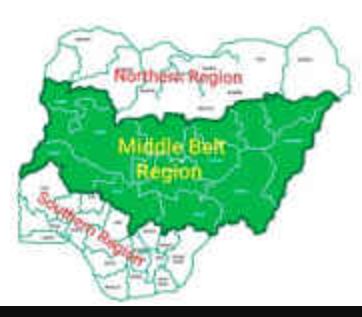
THE MIDDLE BELT IS NOT THE NORTH NOR AREWA: THE CARDINAL HISTORICAL LIE
Perhaps the most enduring and catastrophic legacy of Sardauna’s political architecture is the geographic and administrative fiction it bequeathed to Nigeria: the idea that the Middle Belt is part of “the North.” This fiction was not innocent. It was calculated.
The Middle Belt comprises the indigenous peoples of the geographical center of Nigeria — the Jos Plateau, the Benue Valley, the Niger confluence zones, the Kaduna hinterlands, southern Bauchi, southern Adamawa, and southern Taraba. These peoples share no common ethnicity, religion, or political tradition with the purported “Hausa-Fulani” Muslim north. They are predominantly Christian and traditionalist. Their pre-colonial political structures were acephalous or organised around their own chieftaincies, entirely distinct from the emirate system. The Middle Belt region was referred to as the “Pagan Region” while the Arewa North as the “Mohamadeans”. The Missionaries had before the amalgamation begged Lugard not to mix the two regions.
When British colonialism amalgamated these peoples into the “Northern Protectorate” and later the “Northern Region,” it was an administrative convenience — not a historical, cultural, or ethnic truth. Sardauna inherited this convenience and actively consolidated it. Rather than allowing these nationalities to express their distinct identities — to seek their own region, their own political representation, their own autonomy — he worked to suppress the Middle Belt separatist movement.
The Middle Zone League, formed in the 1950s by Middle Belt leaders including Chief Rwang Pam, J.D. Gomwalk, and others, explicitly called for a separate Middle Belt Region, arguing that their peoples were distinct from the Hausa-Fulani north and deserved their own political expression. The NPC under Sardauna opposed this vigorously. The British colonial government, in concert with Northern political interests, refused to concede. The Middle Belt was locked into “the North” — against the clearly expressed wishes of its own peoples.
This was not nation-building. This was the illegal forced absorption of native indigenous peoples into the Imperialist Fulani empire that had never conquered them and further refused to acknowledge their humanity on their own terms.
Today, when Fulani herdsmen slaughter Ron, Mwaghavul or Berom farmers on the Jos Plateau, when Tarok villages are raided, when Ngas communities are displaced, the political architecture that enables this impunity is the same architecture Sardauna built: a “Northern” political identity that privileges Fulani immigrant interests and treats the autochthonous Middle Belt as a subordinate demographic to be managed, not a people to be served.
INSTITUTIONS OF DEVELOPMENT OR INSTRUMENTS OF DOMINANCE?
Al-Amin Isa lists Sardauna’s institutional achievements with admiration: the NNDC, the Bank of the North, ABU, the Broadcasting Company of Northern Nigeria. But the question is not whether these institutions existed. The question is: who controlled them, who benefited from them, and who was systematically excluded from their leadership?
Ahmadu Bello University, for all the lofty vision Al-Amin Isa quotes, was named after the Sardauna himself — a sitting regional premier. Its foundational leadership and institutional culture reflected the Hausa-Fulani Muslim establishment. It is the same University that fiercely opposed the establishment of the University of Jos. The Bank of the North was not established to empower Berom tin miners or Tiv subsistence farmers or Idoma traders. The Northern Regional Development Corporation directed investment along lines that reinforced the economic dominance of emirate cities — Kano, Kaduna, Sokoto — over the resource-rich but politically marginalized Middle Belt.
The tin fields of Jos Plateau, among the richest mineral deposits in colonial Africa, were extracted primarily for the benefit of the colonial economy and later the federal center, while the Berom and Angas communities who lived on this land saw their farmlands destroyed by mining, their communities displaced, and their political authority diminished by the imposition of emirate-aligned governance structures. Sardauna’s purported development institutions did nothing to reverse this injustice. They institutionalized it.
AL-AMIN ISA’S GREATEST EVASION: THE QUESTION OF BLAME-SHIFTING
Al-Amin Isa argues, with some rhetorical force, that blaming Sardauna for every modern failure of the North — poverty, almajiri crisis, insecurity, educational decline — is intellectually lazy, since Sardauna died in 1966 and every failure since then is the responsibility of subsequent leaders. He is correct in one narrow sense: individual governors, ministers, and officials after 1966 bear their own culpability.
But this argument ignores the most fundamental principle of institutional analysis: path dependency. The structures Sardauna built — the political culture he entrenched, the identities he suppressed, the hierarchies he hardened — did not dissolve with his assassination. They persisted. They were inherited. They were reproduced. The emirate-centered Native Authority system that denied Middle Belt communities genuine local self-governance was not dismantled after 1966. The political culture in which Islamic identity and Northern identity were fused, leaving Christian minorities permanently marginalized, was not reformed after 1966. The land tenure arrangements that dispossessed indigenous communities were not reversed.
When we speak of Sardauna’s legacy, we do not speak of a man long dead. We speak of an imperialist system still breathing — the Fulani system that tells a Berom farmer in Rukuba that his ancestral land now belongs to a “cattle route”; the system that tells a Tarok family in Shendam that armed herdsmen enjoy more state protection than they do; the system that tells Christians in Northern Nigeria that they are guests in their own homeland.
THE HAUSA RENAISSANCE GAMBIT AND THE REAL THREAT TO NORTHERN MINORITIES
Al-Amin Isa’s opening paragraphs are revealing in their paranoia. He describes the so-called “Hausa Renaissance” as a Western plot, operated through atheists and Islam-haters, designed to weaken Muslim unity by promoting “Hausa Zalla” — the idea of a distinctly Hausa (as opposed to Hausa-Fulani) identity. He sees in any internal Northern critique the hand of foreign manipulation.
This conspiratorial framing is not accidental. It is the standard instrument by which the Sokoto-aligned Fulani establishment has always silenced dissent within the North. When Middle Belt Christians demand justice, it is blamed on Western missionaries. When Hausa intellectuals question Fulani dominance, it is blamed on Western agents. When indigenous communities resist land seizure, it is blamed on Southern politicians. The one explanation that is never permitted is the simplest and most accurate one: that the peoples of Northern Nigeria, particularly the Middle Belt and non-Fulani groups, have legitimate, home-grown, historically grounded grievances against a foreign imperialist immigrant political order of the Fulani that was never theirs.
The real threat to Northern minorities is not the Hausa Renaissance. It is the continuation of exactly the Sardauna model: a politics of manufactured Northern unity that conceals Fulani immigrant dominance behind the facade of Islamic solidarity, and that treats the autonomy, land rights, and political identity of indigenous peoples as negotiable obstacles to be managed rather than sacred rights to be respected.
WHAT HISTORY ACTUALLY OWES THE MIDDLE BELT
Al-Amin Isa concludes that “the North deserves better” than false history. On this, we agree — but precisely not in the direction he intends. They insist that the North, properly understood, includes the Middle Belt. Therefore, the Middle Belt deserves a history that tells the truth: that its peoples were conquered twice — first by the British colonialism — and then the post-colonial Fulani imperialist political order, under immigrants like Ahmadu Bello, who institutionalized rather than reversed their subjugation.
The Middle Belt deserves to have its identity restored — not as a subset of “the North,” not as a peripheral appendage of the Sokoto caliphal imaginary, but as the distinct, ancient, legitimate civilizational zone that it has always been. The peoples of the Jos Plateau, the Benue Valley, the Kaduna highlands — they were here before the Fulani came, and were never conquered by the Fulani. They will be here long after Nigerians have enough and send the immigrants back to where they are from.
Sardauna was not a Nigerian founding father in any sense or even creative stretch of the imagination. He and his ancestors and descendants are immigrants, not native to any part of Nigeria. He is also the architect of the fake Northern political order whose true purpose served Fulani arewa immigrant imperial interests at the expense of native indigenous communities. His institutions seemed real — but their structural bias and anti-Nigerian nature was equally real. His purported development projects were claimed to have been done — but so did the dispossession of natives they enabled. His purported One North vision was ambitious — the cost, borne by native peoples who despite owning the entire system, had no vote in designing it.
History deserves better than hagiography. And the Middle Belt and all native indigenous peoples deserve better than being told, yet again, to sit quietly while its erasure is celebrated as someone else’s legacy.
CONCLUSION:
THE SARDAUNA MYTH MUST BE DISMANTLED
Khaleed Yazeedu’s original article may have been imperfect in its framing. Al-Amin Isa’s rejoinder is far worse — it is a white-wash of documented harm. The Sardauna was a consequential leader. That much is undeniable. But consequence is not synonymous with virtue. Hitler built autobahns. Stalin industrialized the Soviet Union. The question is not what was built, but at whose expense, for whose benefit, and on whose broken dignity.
For the indigenous peoples of the Middle Belt — Ron, Mushere, Berom, Birom, Tiv, Jukun, Idoma, Ngas, Mwaghavul, Taroh, Gbagyi, Chamba, Longuda, Igala, and all the rest — Sardauna represents not a founding father but the despicable spawn of their dispossessor: the man who formalized their political invisibility, legitimized their administrative subjugation, and wrapped illegal Fulani immigrant imperialism in the respectable language of regional patriotism.
I repeat again that the Fulani are Immigrants and can never be Indigenes of any part of Nigeria as they are not native to any part of Nigeria. We the true indigenes and natives of Nigeria will never forget that they are not part of us and will never be accepted as part of us.
The Middle Belt is not the North. It was never the North. And until Nigeria honestly confronts what Sardauna’s “One North/Arewa” vision actually meant for the native peoples it absorbed without their consent, there can be no genuine peace, no justice, and no healing on the Jos Plateau, in the Benue Valley, or any part of Nigeria.
We do not need to poison memory. We need to recover the memory that was stolen from us. And that recovery begins with calling the Sardauna myth precisely what it is: an instrument of Fulani immigrant imperialist domination dressed in the false garments of Nigerian nationalism.
SELECT REFERENCES
Ahmadu Bello, My Life (Cambridge University Press, 1962)
Yusufu Turaki, The British Colonial Legacy in Northern Nigeria (ECWA Productions, 1993)
Bala Usman, The Manipulation of Religion in Nigeria (Vanguard Publishers, 1987)
Ishaya Aku, The Middle Belt in Nigerian Politics (Afab Publishers, 1993)
International Crisis Group, ‘Nigeria: The Challenge of the North’ Africa Report No. 213 (2014)
Toyin Falola, Violence in Nigeria: The Crisis of Religious Politics and Secular Ideologies (Rochester University Press, 1998)
S.O. Jemibewon, A Combatant in Government (Heinemann, 1978)
Parrot Newspaper, October 12, 1960 (attributed statement of Ahmadu Bello)
C.S. Momoh (ed.), The Nigerian Civil War 1967-1970: History and Reminiscences (Sam Bookman, 2000)
Encyclopedia Africana, Vol. on Nigerian Founding Figures (Encyclopedia Africana Commission, 1977)
About The Author




More Stories
PLATEAU GOVT CONDEMNS ATTACK ON TRADERS RETURNING FROM KARA MARKET, ORDERS PROBE
Plateau: BYM Demands Revocation of Mining Lease.
Plateau Attacks: NBA Demands Action, Urges Citizens to Report Rights Abuses